Sangwoo Han

Postdoctoral Researcher, University of Washington, Seattle

I am a seismologist and a postdoctoral researcher at the University of Washington, working with Marine Denolle and Paul Bodin on multi-hazard, multi-sensor monitoring at Mount Rainier. I received my Ph.D. in Seismology and Geophysics from Seoul National University in 2026. My research uses dense seismic arrays and distributed acoustic sensing (DAS) to resolve fault structure and earthquake rupture complexity at sub-kilometer scales.

Sangwoo Han in front of Mount Rainier

Research interests

Methods

Rupture process analysis, EGF analysis, slip inversion, back-projection, focal mechanisms, stress inversion, microseismicity detection and location, waveform modeling, DAS, receiver functions

Education

Ph.D. in Seismology and Geophysics (combined M.S.–Ph.D. program)
Seoul National University, Seoul, Korea
  • Thesis: Resolving fault structure and rupture complexity at sub-kilometer scales in small-to-moderate earthquakes
B.S. in Earth and Environmental Sciences; B.S. in Computational Sciences
Seoul National University, Seoul, Korea
  • Summa Cum Laude

Experience

Academic positions

Postdoctoral Researcher
University of Washington, Seattle, WA, USA
  • Advisors: Marine Denolle & Paul Bodin
  • Multi-hazard, multi-sensor monitoring at Mount Rainier
Visiting Researcher
Rice University, Houston, TX, USA
  • Advisor: Jonathan Ajo-Franklin
  • Microearthquake detection and location using distributed acoustic sensing (DAS) and a nodal geophone array in Imperial Valley, California

Field deployments

DAS and geophone array, Korea National University of Education
Linear geophone array, Hongseong-Yugyu area
Linear geophone array on the fault zone of the 2016 Mw 5.5 Gyeongju earthquake

Research Highlights

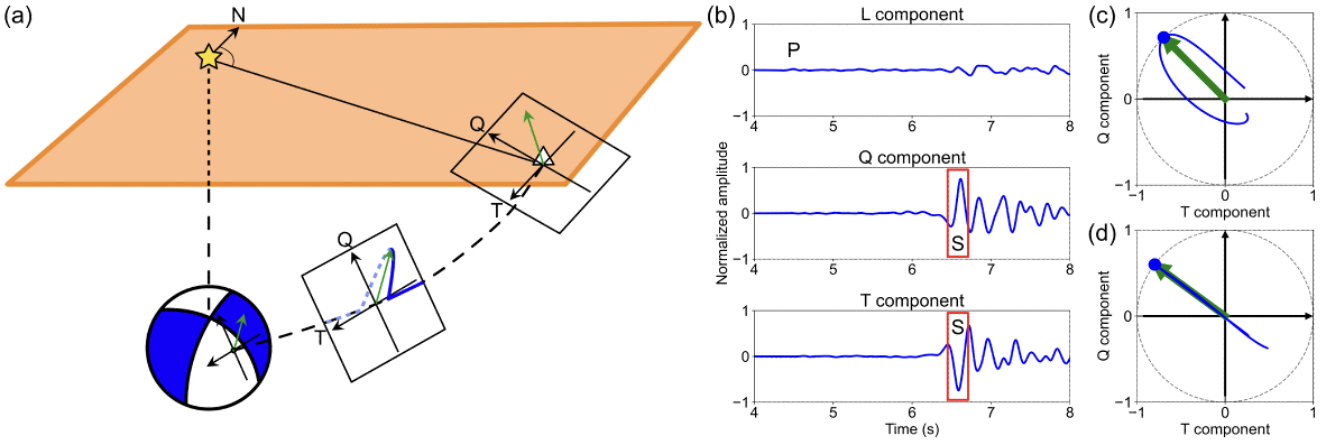
Focal mechanisms of small earthquakes from 360° S-wave polarization

We showed that measuring the full 360° S-wave polarization at near-source stations recovers the double-couple radiation pattern, so that reliable focal mechanisms can be obtained from as few as two to three stations. Applied to a dense seismic array in Korea, the method determines focal mechanisms for events from M 2.9 down to M −0.4, and it is validated with the 2023 Parkfield and 2011 Mineral, Virginia, earthquake sequences.

Schematic of measuring S-wave polarization at a station, with L, Q, and T component waveforms and S-wave particle motion

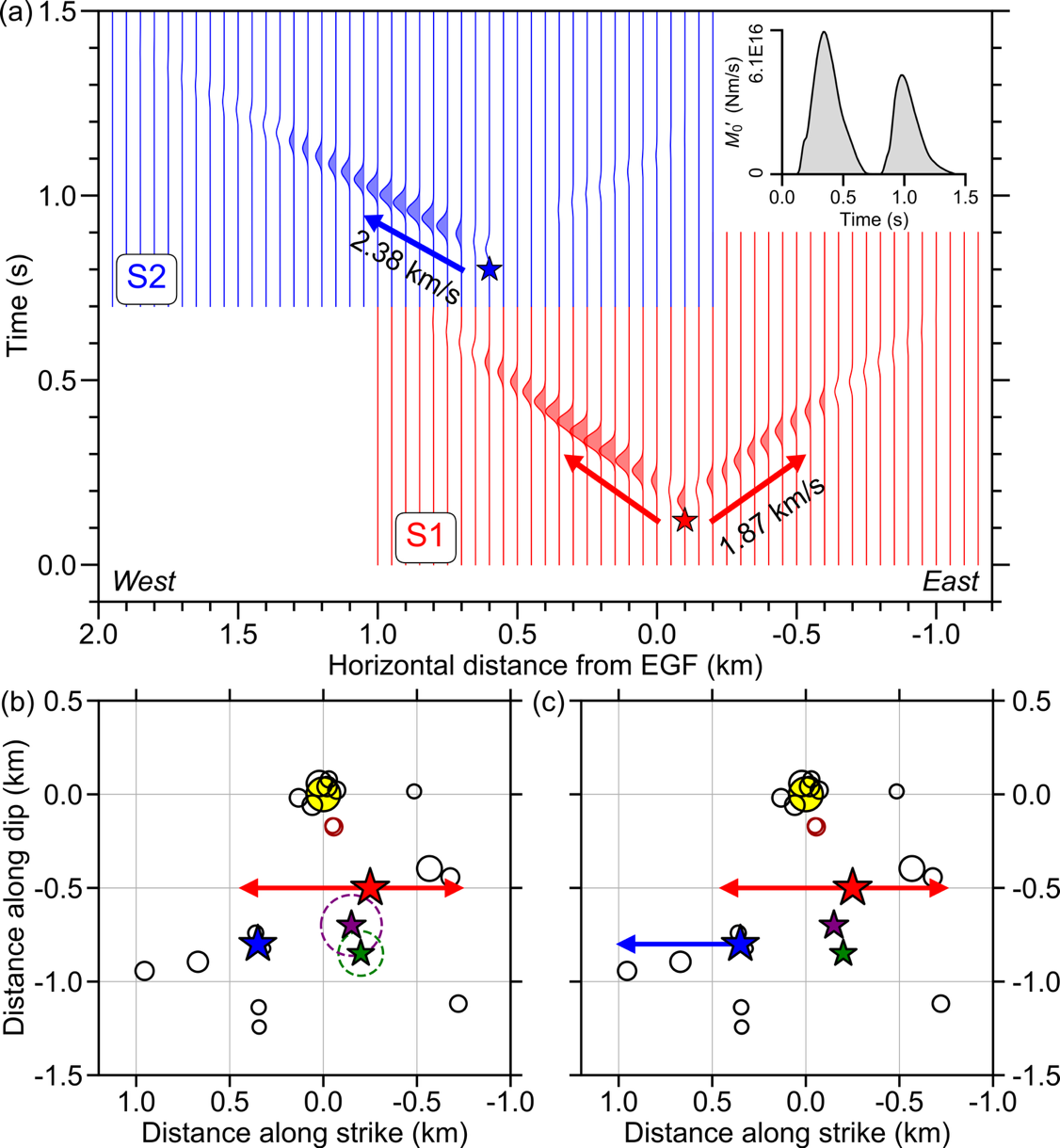
Multi-stage rupture of the 2021 Mw 4.9 offshore Jeju Island earthquake

Using local P and S waves and regional Lg waves, we resolved the complex rupture of this moderate earthquake on the southern Korea–East China Sea continental shelf. Relative source time functions show that the first subevent started with two weak nucleation phases and propagated slowly and bilaterally, and that a second subevent then ruptured westward. This cascading rupture of successive fault patches shows how a moderate-sized earthquake can be generated in an intraplate setting.

Fault-slip inversion of subevents S1 and S2 with rupture velocities, moment rate function with two peaks, and subevent locations along strike and dip

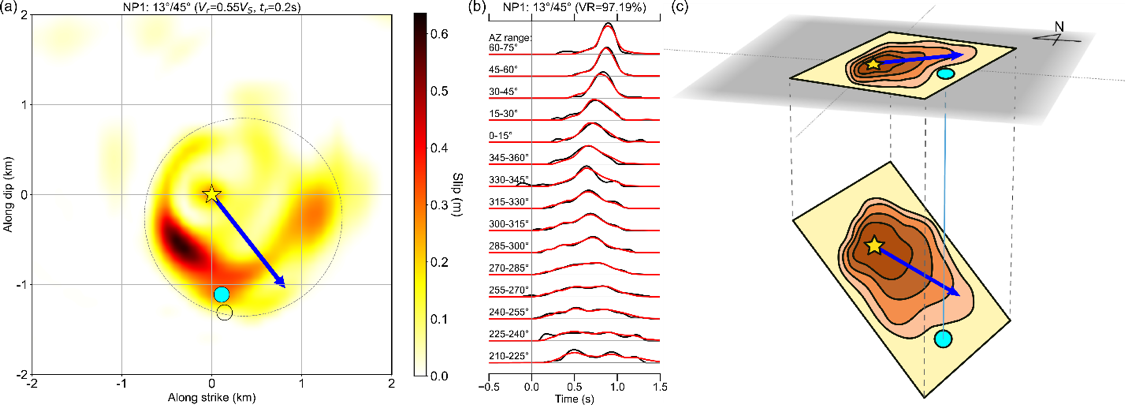
Rupture model of the 2024 Mw 4.8 Tewksbury, New Jersey, earthquake

Millions of people around New York City felt this earthquake, but the epicentral area experienced no known significant damage. Fault slip models from regional Lg-wave relative source time functions show the rupture propagating toward the east-northeast and down-dip on an east-dipping fault, which may account for the lack of strong shaking near the epicenter. This event clearly demonstrates that rupture directivity can cause asymmetric propagation of ground shaking even in a moderate-sized earthquake.

Slip distribution on the fault plane, observed and synthetic Lg-wave source time functions by azimuth, and a 3D sketch of down-dip rupture

Publications

  1. Determining small earthquake focal mechanisms using 360° S-wave polarization: Insights from dense seismic arrays

    Han, S. & Kim, Y. (2026). Geophysical Journal International, 244(3), ggaf530. doi:10.1093/gji/ggaf530

  2. Complex multi-patch rupture and aftershock characteristics of the 2024 Mw 4.2 Buan, Korea, earthquake sequence

    Seo, M.-S., Kim, W.-Y., Han, S., Park, J. Y., & Kim, Y. (2026). Seismological Research Letters, 97(3), 1767–1781. doi:10.1785/0220250261

  3. Rupture model of the 5 April 2024 Tewksbury, New Jersey, earthquake based on regional Lg-wave data

    Han, S., Kim, W.-Y., Park, J. Y., Seo, M.-S., & Kim, Y. (2024). The Seismic Record, 4(3), 214–222. doi:10.1785/0320240020

  4. Resolving multi-stage rupture process of the 2021 Mw 4.9 offshore Jeju Island earthquake from relative source time functions

    Han, S., Kim, W.-Y., Lim, H., Son, Y. O., Seo, M.-S., Park, J. Y., & Kim, Y. (2024). Geophysical Research Letters, 51(3), e2023GL106059. doi:10.1029/2023GL106059

  5. The 28 October 2022 Mw 3.8 Goesan earthquake sequence in central Korea: Stress drop, aftershock triggering, and fault interaction

    Kim, W.-Y., Seo, M.-S., Park, J. Y., Han, S., Son, Y. O., & Kim, Y. (2023). Bulletin of the Seismological Society of America, 113(6), 2416–2431. doi:10.1785/0120230078

  6. The 14 December 2021 Mw 4.9 offshore Jeju Island, Korea, earthquake: Seismological observation of an intraplate earthquake provides insight into regional seismotectonics

    Kim, W.-Y., Park, J. Y., Seo, M.-S., Son, Y. O., Lim, H., Han, S., & Kim, Y. (2022). The Seismic Record, 2(2), 107–117. doi:10.1785/0320220012

  7. Deployment of the linear array with geophones on the fault zone of the 2016 Mw 5.5 Gyeongju earthquake

    Lim, H., Kim, Y., Kwon, K. B., Han, J., Ahn, B. S., Chai, G., … & Ree, J. H. (2021). Journal of the Geological Society of Korea, 57(5), 741–746. doi:10.14770/jgsk.2021.57.5.741

Media Coverage

On the rupture model of the 2024 Mw 4.8 Tewksbury, New Jersey, earthquake (Han et al., 2024, The Seismic Record)

Conference Presentations & Invited Talks

  1. Basics of distributed acoustic sensing Invited

    Han, S. (2026). Korea National University of Education.

  2. Multi-episode rupture kinematics of a microearthquake in weak crust revealed by dense DAS observations Invited

    Han, S. (2026). Korea Meteorological Administration.

  3. Multi-episode rupture kinematics of a microearthquake in weak crust revealed by dense DAS observations

    Han, S., Ajo-Franklin, J., Kim, J., Nayak, A., & Kim, Y. (2026). SSA Annual Meeting.

  4. Short- and long-term focal mechanism analysis of the 2016 ML 5.8 Gyeongju earthquake sequence: Insights into spatiotemporal evolution of stress perturbation and micro-fault activation

    Han, S., Seo, M.-S., & Kim, Y. (2026). Spring Meeting of the Korean Society of Earth and Exploration Geophysicists.

  5. High-resolution imaging of microearthquake ruptures using distributed acoustic sensing: Fiber optics as a microscopic lens Invited

    Han, S., Ajo-Franklin, J., Kim, J., Nayak, A., & Kim, Y. (2026). 1st IUGG-Korea Conference.

  6. Revealing meter-scale rupture complexity in small earthquakes using distributed acoustic sensing

    Han, S., Ajo-Franklin, J., Kim, J., Nayak, A., & Kim, Y. (2025). AGU Annual Meeting.

  7. Determining small earthquake focal mechanisms using 360° S-wave polarization Award

    Han, S. & Kim, Y. (2025). SSA Annual Meeting.

  8. Fault complexity revealed by focal mechanisms of small earthquakes in Gyeongju, South Korea: Effective use of S-wave polarizations retrieved from the high-density seismic array

    Han, S. & Kim, Y. (2024). 37th International Geological Congress.

  9. Improving focal mechanism solutions with 3-D S-wave ground motion: Toward routine determination of the focal mechanisms and detailed earthquake source characterization with Gyeongju Hi-density Broadband Seismic Network (GHBSN) data

    Han, S. & Kim, Y. (2024). Asia Oceania Geosciences Society Annual Meeting.

  10. Resolving source parameters and multi-stage rupture process of the 2021 Mw 4.9 offshore Jeju Island (Korea) earthquake

    Han, S., Kim, W.-Y., Lim, H., Son, Y. O., Seo, M.-S., Park, J. Y., & Kim, Y. (2023). AGU Annual Meeting.

  11. Focal mechanism determination from the 3-D ground motion of S wave: Towards detailed earthquake source characterization with Gyeongju High-Density Broadband Seismic Network (GHBSN) data

    Han, S. & Kim, Y. (2023). Joint Fall Meeting of Korean Geological Societies.

  12. Multi-stage rupture process of the 2021 Mw 4.9 offshore Jeju Island earthquake from relative source time functions

    Han, S., Kim, W.-Y., Lim, H., Son, Y. O., Seo, M.-S., Park, J. Y., & Kim, Y. (2023). Joint Fall Meeting of Korean Geological Societies.

  13. Source complexity of the 2021 Mw 4.9 offshore Jeju Island, Korea, earthquake

    Han, S., Kim, W.-Y., & Kim, Y. (2022). AGU Annual Meeting (online).

  14. Analysis of complex rupture process of 2021 Mw 4.9 offshore Jeju Island earthquake

    Han, S., Kim, W.-Y., Lim, H., Son, Y. O., Seo, M.-S., Park, J. Y., & Kim, Y. (2022). Joint Fall Meeting of Korean Geological Societies.

  15. Back-projection imaging of small earthquake ruptures using the data from Gyeongju High-Density Broadband Seismic Network Award

    Han, S. & Kim, Y. (2021). Joint Fall Meeting of Korean Geological Societies.

Awards & Honors